
Learning the Language of Padel: What to Know Before Stepping On Court

A new sport is shaking up the racquets scene: Padel. Pronounced “paddle,” this fast-growing game with its glass-enclosed courts is spreading across the U.S., appearing at dedicated racquets facilities and private clubs that recognize its potential. With deep roots in South America and Spain, padel blends elements of tennis, squash and racquetball into a game that prizes strategy, finesse, and teamwork over raw power.
Though it shares familiar elements with other racquet sports, the game’s unique court and style of play can feel intimidating at first. This guide breaks down the essential padel facts, terminology, and must-know details to help you step onto the court with confidence and start enjoying your next racquets obsession.
A Sport with a Spanish Accent
Padel’s global growth has been driven largely by Spain and South America, so expect a strong Spanish influence—especially when it comes to terminology. As you progress beyond the basics, you’ll start hearing Spanish terms used to describe key shots and tactics that are central to the game:
Bandeja – The bandeja, which translates to “tray,” gets its name from the shape of your racquet during the shot. Imagine a waiter holding a large tray with their palm facing up—your racquet mirrors that position. This controlled, sliced overhead is used to neutralize an opponent’s lob while keeping
Víbora – A “viper” shot, the Víbora is an aggressive, high-speed overhead with side spin, designed to make the ball bounce low off the glass.
Chiquita – A soft, low shot aimed at the feet of the net players.
Bajada – A downward shot played from the wall or at height, typically intended to end the point or push opponents back.
Learning the “language of padel” is part of the fun and a sign you’re starting to play the game the right way. Understanding these shots early will give you an edge in both strategy and court awareness.
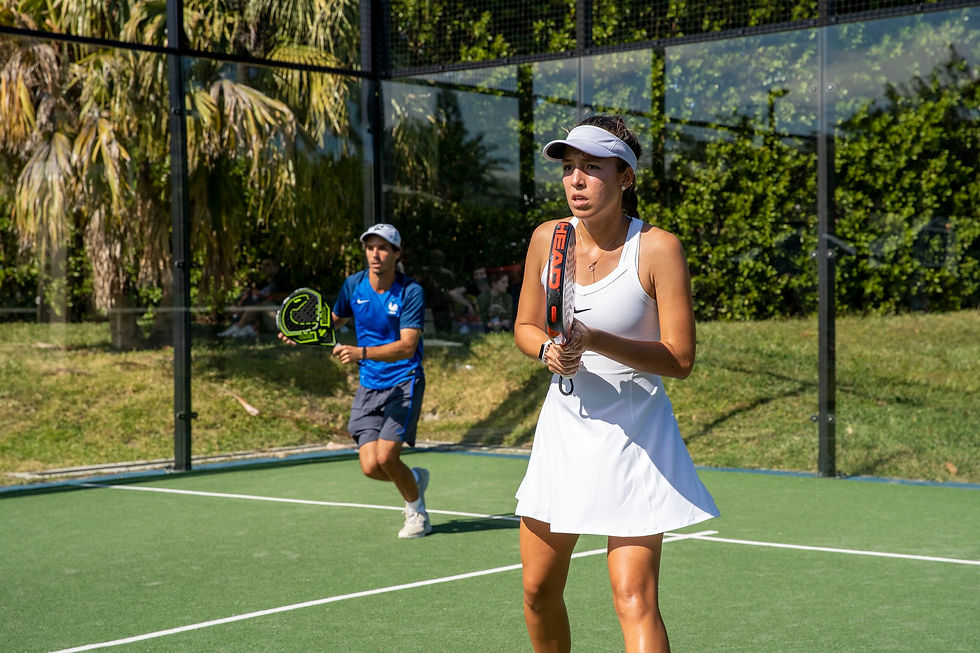
Doubles Only, Always
Unlike tennis or pickleball, padel is played exclusively as doubles. The smaller court and enclosed walls make teamwork and communication essential. Good news—this also means padel has a naturally social
vibe, and players of slightly different skill levels can still have competitive, enjoyable matches together.
Power Is Optional—Touch Is Not
If there’s one habit tennis players must unlearn, it’s hitting too hard. For tennis players, the challenge isn’t usually ability when they try out padel; it’s restraint.
Padel rewards control, patience, and placement far more than pace. Soft lobs, angled shots, and well-timed balls at the net player are often more effective than driving the ball through the court. Think chess, not checkers.
That said, some tennis skills absolutely carry over:
Strong volleys translate extremely well
Overheads are a major weapon
Net awareness gives you an edge
Serve-and-volley is a core strategy, and most attacking plays and well-constructed points are finished at the net.
The Walls Change Everything
Unlike most outdoor racquet sports, padel courts are enclosed with glass and fencing, and the ball must bounce on the ground before hitting a wall to remain in play. Learning how to position yourself and use the walls is one of the biggest learning curves for new players.
Once you get comfortable playing off the walls and adjusting your position for their rebounds, the game opens up dramatically.
Equipment: Not a Paddle (Technically)
Despite the naming similarities, padel equipment is officially referred to as a racquet, not a paddle. Similar to a pickleball paddle, a padel racquet does not have any strings. Instead, the carbon fiber racquet is drilled with holes (one, at minimum) that increase the aerodynamics and reduce the weight, making for an easier, more maneuverable swing.
Compared to tennis and pickleball gear, padel racquets are much heavier, with typical weights ranging from 350-380 grams. Like racquets and paddles, however, different models vary by balance, weight, and even surface grit so every player can find a frame that feels comfortable.
Last but perhaps most importantly, padel racquets are equipped with an adjustable wrist strap that must be worn during play for safety. The wrist strap is not optional—in fact, you can lose the point if you play without it.
The ball looks similar to a tennis ball but is slightly smaller with lower compression, contributing to the game’s softer feel.
Tennis shoes are perfectly acceptable, and courts are typically surfaced with astro turf, a bouncy surface that is much easier on the joints, and can even be played on in damp conditions.
Serving, Scoring, and Structure
Tennis players will appreciate that scoring is exactly the same as tennis. Serving also has some similarities, with first and second serves allowed. In contrast, the serve motion is purely underhand, and the ball must bounce before contact. Picture a pickleball serve, but with a bounce before you hit it.
Fitness, Cost, and Club Culture
Padel, not unlike tennis and pickleball, delivers a deceptively good workout and cardiovascular benefits thanks to constant movement and quick directional changes.

That said, padel can be expensive and even difficult to access, particularly in the U.S.:
Racquets often range from $200–$400+
Court fees range from $20 per hour to $100+ in popular areas or large cities
Courts are most commonly found at private or padel-specific clubs, not public facilities like parks or recreation facilities
When looking for a place to play, start with a beginner program where you can learn the fundamentals and build a strong strategic foundation. Over the long term, seek out a club with an active social scene and players across multiple skill levels, which will allow your game to evolve and stay engaging. The community aspect is a major part of padel’s appeal and a key reason players stick with the sport.
Final Thought
Padel speaks its own language, but it’s one tennis players can learn quickly—and enjoy immediately. With familiar scoring, transferable net skills, and a strong social culture, padel offers a refreshing, strategic alternative that feels both new and comfortably familiar.
Brush up on your Spanish, soften your swing, and get ready to play the walls.
Thank you for sharing this valuable post. The information was well-presented and easy to follow. I always enjoy reading content that provides practical insights and a fresh perspective on different topics. While exploring educational opportunities, I recently learned about how to get admission at northern state medical university , and it's interesting to see how students today have access to a wide range of global learning options. Looking forward to more informative articles from your blog.
Padel sounds quite interesting because it relies not only on strength but also on strategy, skill, and teamwork. For beginners, a tutorial explaining the rules, terminology, and gameplay like this is well worth watching. We also share information about Block Blast for those looking for a lighthearted game.
Many sports jackets are designed more for looks than comfort, but this one stands out. You can view it here: Chicago Bears Snap-Tab Varsity Jacket — well-constructed and true to team spirit.